
A real Damascus knife gets its pattern from layers of different steels forged together. A fake one has the same look printed, laser marked or stained onto a single piece of plain steel. In a product photo the two can look identical, which is why so many cheap knives are sold as Damascus.
This guide explains what the word means today, what fakes are made of, and seven checks you can run before you buy. We sell handmade Damascus knives at Demaxes, so we have an interest in this topic. The advice below applies whoever made the knife you are looking at.
Key takeaways
- Today, “real Damascus” almost always means pattern-welded steel: different steels forge-welded into layers, then etched to show the pattern.
- The original Damascus steel was a different material, wootz crucible steel, and production of those historic blades faded out around 1900.
- Acid etching does not make a knife fake. Etching is how a real pattern is revealed.
- The pattern should be part of the blade. Look at the spine, the tang, the butt and the bevel, not just the flat of the blade.
- A listing that names the steels (for example 1080 and 15N20) tells you more than a big layer count.
What “real Damascus” means today
Damascus steel first meant the high-carbon crucible steel of historic swords, made with the wootz process in the Near East. Those blades had banding that looked like flowing water. The wootz ingots were imported from southern India, and production of the patterned blades ended around 1900 (Wikipedia: Damascus steel).
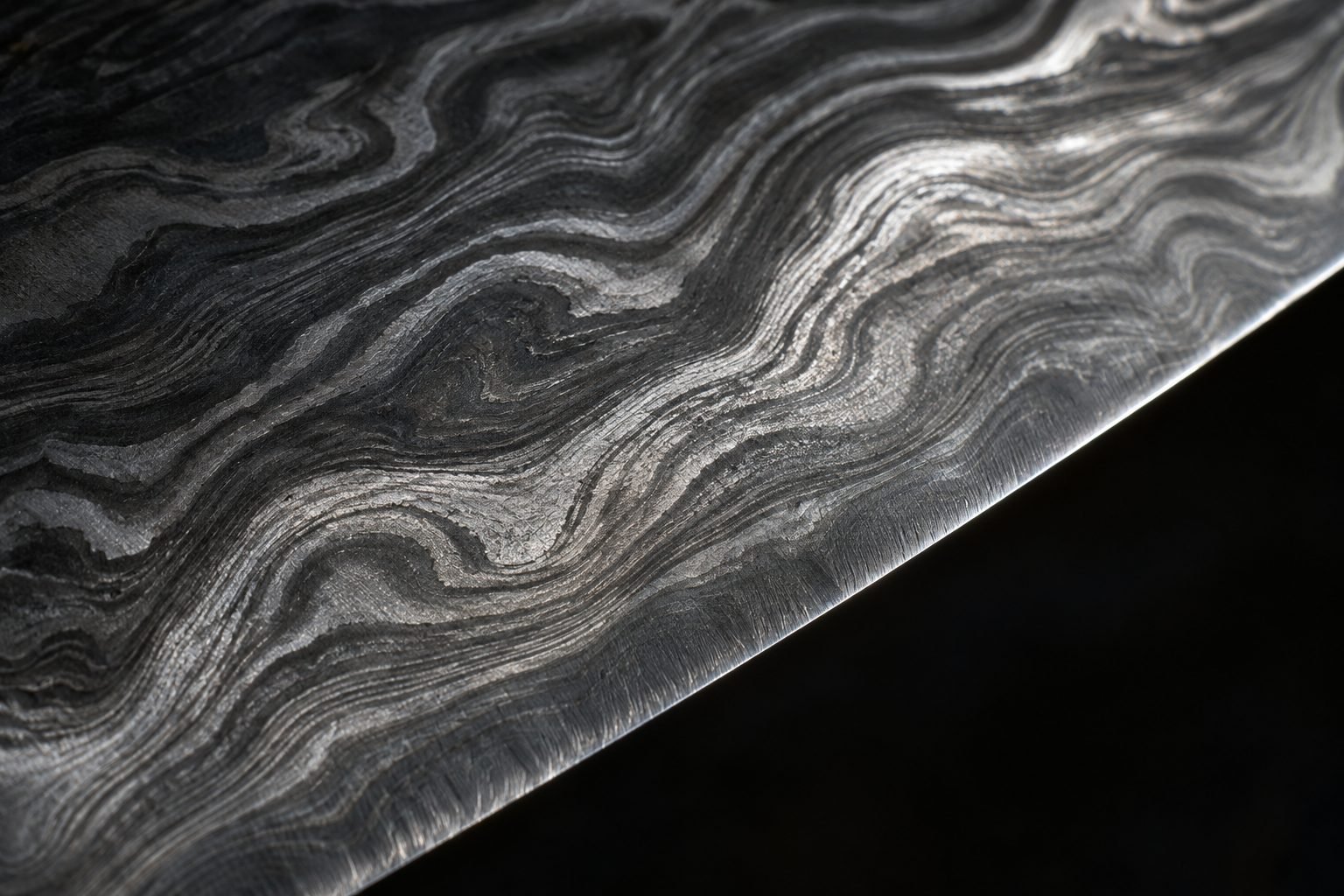
Modern knives use another method called pattern welding. A smith stacks different steels, forge-welds them into a billet, then draws it out and folds it until the layers are right. Each steel reacts differently to acid, so etching leaves alternating light and dark bands. For example, acid darkens 1080 carbon steel more than it darkens 15N20 nickel steel (Wikipedia: Pattern welding).
Pattern-welded steel has been sold as “Damascus” since the 1970s. The name is technically incorrect, but it is now accepted across the knife trade for layered blades. That is the standard this article uses: a real Damascus knife today is a layered, pattern-welded blade whose pattern runs through the metal.
What fake Damascus looks like
A fake is usually one piece of ordinary steel with a pattern added to the surface. The pattern can be etched, laser engraved, printed or stained on. Sellers do it because forging layered steel takes time, and a surface pattern is far cheaper to produce. In photos it looks like Damascus. In your hand it behaves like the plain steel underneath, and a surface pattern can fade with cleaning and sharpening.
Fake does not automatically mean bad steel. A plain steel knife can be a good knife. The problem is paying a Damascus price for a pattern that sits only on the surface.
Seven checks before you buy
1. Follow the pattern across the whole knife
On a layered blade the pattern is in the metal. It should show on the spine, the tang and the butt wherever those parts are not polished smooth. Do not call a knife fake just because a polished bolster or spine shows no pattern. Polishing can hide it. But a pattern that appears only on the flat of the blade and nowhere else deserves a question.
2. Look at the bevel
When a layered billet is ground to an edge, the grind cuts through the layers at an angle. On a real blade, the lines usually curve and follow the shape of the bevel. A printed pattern tends to stay the same from the flat of the blade to the edge.
3. Be careful with patterns that look too perfect
Real patterns have small irregularities, because they come from hot metal being worked by hand. Identical repeating motifs, perfect symmetry or a logo sitting inside the pattern suggest a laser or a print. There is one exception. Some smiths build mosaic patterns on purpose, even with letters or pictures, so if the design looks planned, ask the seller how it was made (Wikipedia: Pattern welding).
4. Wipe the blade if you already own it
Wipe the blade with a soft cloth and a little oil. A stained or printed pattern can smear, lift or look patchy. A layered pattern will not change. This only helps with the cheapest fakes, so treat a pass as a good sign and not as proof.
5. Ask which steels were used
A maker of real Damascus can name the steels in the billet, and a common pairing is 1080 and 15N20. A listing that only says “Damascus steel” gives you nothing to check. Layer counts are a weaker signal. Smiths do care about layers: the American Bladesmith Society requires a Damascus blade of at least 300 layers for its Master Smith rating (Wikipedia: Damascus steel). But a number typed into a listing proves nothing by itself.
6. Check the seller and the price
Layered steel takes real time to make, so a very low price for a large “Damascus” set is a warning. Price alone proves nothing in either direction. Look for photos of the exact knife, a named maker or workshop, clear steel details and a return policy. Handmade knives differ from one another, so identical photos on every listing can mean stock images.
7. Re-etch the blade only as a last resort
Some makers describe an etch test. You polish a small patch until the pattern disappears, then etch it again with acid. On real Damascus the pattern comes back, and on a fake you get random marks. The test changes the finish of the blade and uses a hazardous chemical, so run it only on a knife you own and are willing to refinish. For most buyers, checks 1 to 6 and a good return policy are enough.
Real vs fake Damascus at a glance
| Check | Real (pattern-welded) | Fake (surface pattern) |
|---|---|---|
| Where the pattern is | Through the layers of the steel | On the surface only |
| Spine, tang and butt | Pattern shows where the metal is not polished | Often missing or different |
| Bevel | Lines follow the shape of the grind | Pattern looks flat and unchanged |
| Look | Natural small variations | Too regular, or a repeating print |
| Listing details | Names the steels and the maker | “Damascus steel” and nothing else |
| After wear | Pattern stays | Can fade or lift |
Three myths that confuse buyers
“Acid etching means it is fake.” Etching is how the real pattern is brought out. Without it, a polished layered blade looks like plain steel.
“No pattern on the spine means fake.” A polished spine or bolster can hide it. Check the parts of the knife that are left rough or unpolished.
“More layers always means a better knife.” Folding does change the steel. In tested samples, toughness rose as the number of folds went up. But a number in a listing says nothing about how well the knife was heat treated or ground, and the properties of a layered blade sit between those of the steels used to make it (Wikipedia: Damascus steel).
Is a Damascus knife worth buying?
The pattern is the main reason most people buy one, and it is a good reason. How the knife cuts depends on the steels, the heat treatment and the grind, as with any knife. So buy a real one for the craft and the look, and judge performance from the specs you are given.
Real Damascus can rust. Dry the blade after every use and keep a light coat of oil on it. We cover the full routine in how to clean a Damascus knife. If you want the basics first, read what a Damascus knife is and what makes it special.
When you are ready to compare, our hunting knives and pocket knives are handmade Damascus knives with the steel details on each product page. Use the seven checks above on ours too.
FAQ
Can Damascus steel be faked?
Yes. A fake is usually plain steel with a pattern etched, laser marked, printed or stained on the surface. The checks above help you spot it.
Is acid etching a sign of a fake?
No. Layered steels are etched in acid so that the bands of different steels show. Etching is a normal step in making a real pattern-welded blade.
Is modern Damascus the same as wootz steel?
No. Wootz is the high-carbon crucible steel of the historic Damascus swords. Modern Damascus knives are usually pattern-welded from layered steels. The trade uses the same name for both, even though the methods are different.
Does real Damascus steel rust?
It can. Dry the blade after use and keep it lightly oiled, especially if it is made from high-carbon steel.
0 Comments